
We just completed a trip to this state, more specifically Philadelphia and Lancaster with points in between. This was to explore my family’s history and the Revolutionary War. So if you are not interested in these topics, you may wish to skip this post. Plus there are a lot of photos.
I wanted to learn more about my ancestors that lived through the Revolutionary War and their involvement with it. I knew I was also going to learn more about their involvement with slavery. (I explored some of this in my post Slave Holding Ancestors.) So with some trepidation we went to Pennsylvania on September 19. These are all ancestors of my great grandfather Morton Reigart Stone. He is my mother’s father’s father. Here is a tree to try to give a reference to these ancestors.

We headed to Burien after dropping off the beagle at Skagit Canine Club to leave our car there for the trip. My dad was out of town so we were on our own. I decided to go to Angelo’s Restaurant. I am not sure I have been there before but it has been in business since 1957. Tom had Chicken Parmigiana, and I had Angelo Parmigiana. It was all very good. It clearly was a restaurant that had lots of regular customers which was nice. We ordered a couple of small pizzas to go for our flight the next day.

The next morning we had a non-stop flight to Philadelphia. It was a long day. We picked up our rental car and headed north. Here’s the traffic and Children’s Hospital of Philadelphia by the freeway.

An interesting plant. I couldn’t tell if it was being used. There were many large vacant warehouses and businesses noted on our trip which I found sad.

I had created a Lancaster Trip Map on Google My Maps and used it to navigate the trip. I could click on any point, and it could give me directions, information I had entered as to why the place was important, and links to their website to figure out when they were open. Here’s a picture of the map I was using on my phone.

Anyway, using this map I figured out the two places I was interested in going to for dinner were not open. So I then chose Cider Belly Hard Cider is a small-batch craft cidery located in Chestnut Hill. It was amazing. I had trout crisps, and Tom had the nibble board. The meal and the ciders were amazing.


We then drove further and checked into the General Warren Inn near Malvern. It was actually when I had made reservations for this lodging that I was starting to get excited about the trip. The room was really amazing. We were tired so settled in to watch the Mariners work on clenching a post season playoff berth. We had to watch on my phone though.

We had a nice breakfast in the dining room before heading out to check out Valley Forge.

We looked at the visitor’s center first.


Then we decided to take the trolley tour. We had been debating about doing the self driving tour or this. I was hoping to support the rangers in the tour, but it was a private tour guide. She was amazing though and definitely knew her history. We stopped at replicas of the soldiers winter housing.

Oven for baking

Soldier’s quarters

Soldier’s bunks

Chimney

More bunks

Officer’s quarters

Soldier’s gear

replica of a redoubt

map of the front line

monument

statue of General Anthony Wayne

George Washington’s headquarters at Valley Forge


Headquarters’ kitchen and slave quarters
I have been reading Founding Mothers. It describes George Washington dislike of this building which our guide agreed with. But in the book he had a log dining room built where he spent much of his time with Martha and enjoyed more. The book describes 1500 horses dying at Valley Forge. I asked our guide about this, and she confirmed it is true as well as many oxen. They were not buried property and contributed to the disease and death at Valley Forge. I was also curious about the women and children that tagged along with the troops (their husbands and fathers). Apparently they walked behind the troops when they travelled and did stay in their quarters. They contributed by cooking and sewing for the troops.
We then used my trusty map and drove to Saint Peters Village to visit the Snug. The village was really quaint. There were great ciders and conversations at the Snug, and then we went to The Inn at St Peter’s Village for lunch.

We headed back to our room and had a nice dinner there. Then we watched the Mariners working toward their playoff berth.

I was a little disappointed that our dinner had been in the same alcove that our breakfast was in. I was hoping to dine in the historic dining room. Here is a photo of it the next morning.

The is the outside of the General Warren Inn as we were leaving. Our rooms included the two third story windows to the left and middle.

We then headed west to the Saint Paul’s Episcopal Church. Here’s an example of the roads and bridges as we were driving.

Below is the gravestone of my great, great grandfather Henry M. Stone. Here is a memoir created for him:
“Mr. Stone’s first work was with the Pennsylvania Railroad, EasternLines, where he was engaged in the location and construction of the road from Whitings to Bay Head Junction, N. J., and of the “Cut Off”at Lancaster, Pa.
He resigned from the Pennsylvania Railroad to accept a position with the Denver and Rio Grande Railroad, having had charge of the construction of a section of that road in the Rocky Mountains nearDillon, Colo. With the temporary abandonment of this work, he accepted a position with the St. Louis, Iron Mountain and Southern Railroad, and, later, returning to his native State, was employed by a corporation known as the Delaware River, Phoenixville, and Lancaster
Railroad to locate a railroad through the northern part of Lancaster and Chester Counties. He resigned to accept a position with the LehighValley Railroad Company at Sayre, Pa. While with the Lehigh Valley, he was engaged in making surveys for the entrance of that railroad intoBuffalo.
In 1883, Mr. Stone again went West, and accepted a position with theChicago and Northwestern Railroad, with which he remained for more than five years, his principal work being the construction of newlines in the Northern Peninsula of Michigan.
After leaving the Northwestern, he was for a time Engineer of theCairo Land and Construction Company, and in that capacity had charge of the construction and maintenance of the dikes at Cairo, 111. Mr.Stone resigned this position to enter the service of the Chicago,Milwaukee and St. Paul Railroad, where he had charge of double-tracking a considerable section of that road near Marion, Iowa. His next position was with the municipality of Wilmette, 111.
In 1896, Mr. Stone was sent by a Chicago syndicate of capitalists toCape Breton, Nova Scotia, to locate and build a railroad (with docks find terminal facilities) from the Western Coast to the coal fields.In 1900, he became Location Engineer for the Algoma Central Railway, in which capacity he located a considerable portion of the present line of that road. Later, he was appointed Bridge Engineer of the same corporation.
On January 1st, 1903, he entered the service of the Chicago, RockIsland and Pacific Railroad, with which corporation he remained until his death, at different times holding the positions of AssistantEngineer at Lincoln, Nebr., Division Engineer at Fairbury, Nebr” andLittle Rock, Ark., Location Engineer in charge of location and construction in Texas and Louisiana, District Engineer of the NorthernDistrict at Cedar Rapids, Iowa, and of the Southwestern District atTopeka, Kans., and Chief Engineer of the Chicago, Rock Island and Gulfat Fort Worth, Tex. With the abolishment of that position he was for a time with the Valuation Department, and, at the time of his death, wasEngineer of Construction in charge of extensive double-track work authorized by the Federal Administration, at Trenton, Mo.
Prior to going to Trenton, Mo., Mr. Stone had been loaned by the RockIsland Railroad Company to the Union Pacific Railroad to take charge of the field work of the reconstruction of the Grand Island Bridge crossing the Missouri River at St. Joseph, Mo.
He was married in Chicago, on September 11th, 1889, to Miss HenriettaReigart, daughter of Adam W. and Mary Bender Reigart, formerly ofLancaster County, Pa.
He is survived by his widow, residing at Kansas City, Mo., and one son, Morton Reigart Stone, Superintendent of the Idaho Fruit ProductsCompany at Meridian, Idaho.
Mr. Stone was elected a Member of the American Society of CivilEngineers on April 3d, 1907.
o Memoir prepared by J. W. Stone, Esq.”
Died of “Spanish flu” while away on job, alone in a hotel room in Trenton, Missouri.
My uncle Craig had provided me with maps and descriptions of where the graves of our ancestors were located. The Find A Grave site was also really helpful for location gravestones and providing some background information. I used it quite a bit this trip. Here is the entry for Henry Stone.

Here are the gravestones for John W. and Hannah A. Stone, his parents as well as his sister Elizabeth Alston. I somehow missed the gravestone for his other sister, Amy Stone.

I then realized that we should have brought flowers to decorate their graves. So we found the nearest flowers we could find and returned. Here are the graves with the flowers.


Here is their church.


We then headed to Bangor Episcopal Church. Here we found the graves of David and Martha Armon Jenkins. These are my grandparents 8 generations back. David was Col of the 10th Batt., Lancaster County Militia 1777. (PA Arch. s 5, v 7, 974-975-991; PA Arch. s 6, v 11, p 218). He was an original Trustee of old Pequea presbyterian Church. He served as Justice of the Peace for 7 years, and presided with 4 other men over the Court of Quarter Sessions at Lancaster. Unfortunately I did not get a great photo of the gravestone.

Here is their son’s grave, John Jenkins, Jr. John served as a Private in the 4th Co., 5th Battalion, under Captain Joseph Jenkins. He was killed accidentally while riding horseback.
This is the grave of Margaret Jenkins Kreider, their daughter.

Here is another John Jenkins, the brother to David Jenkins, my ancestor. John also served as a Private in the 4th Co., 10 Battalion, under Capt. Joseph Jenkins.

This is the gravestone of his wife, Elizabeth Jenkins.

This is the gravestone of their son, William Jenkins.


Here are photos of the graves with flowers.


We then headed to Caernarvon Historical Society and Museum. We were greeted by this friendly Welsh Corgi.

We found the grave monuments for Catharine Carmichael Jenkins and Robert Jenkins. Robert was a US Congressman. He was an iron master in Caernarvon Township, Pennsylvania and a member of the State House of Representatives in 1804 and 1805. In 1807, he was elected as a Federalist to the Tenth and Eleventh Congresses, serving until 1811. After his term, he was member of a Group of Horse and took an active part in suppressing the Whisky Insurrection in Pennsylvania.
There is also a monument for their son John Jenkins and his wife, Annis. Per Wikipedia, John Jenkins “was born on December 13, 1809, at the Windsor Forge Mansion in Churchtown, Pennsylvania… He graduated from Dickinson College in Carlisle, Pennsylvania, and received a Doctorate in Medicine from the Medical School at the University of Pennsylvania in Philadelphia in 1833. He moved to the Wilkinson County, Mississippi, to take over the medical practice of his uncle, John Flavel Carmichael (unknown-1837), a medical doctor and plantation owner who had become blind. He owned several plantations in the Natchez District, some of which he inherited, some of which he purchased and developed. For example, he owned the Cold Spring Plantation in Pinckneyville, Mississippi. Additionally, he owned several other plantations like the Stock Farm Plantation near Nesbit, Mississippi, in DeSoto County, Mississippi, the Tarbert Plantation in Wilkinson County, Mississippi, and another plantation in West Feliciana Parish, Louisiana. A horticulturalist, he would use his Natchez residence, Elgin, as a plant nursery for different varieties of fruit trees and cotton he would later use on other plantations. He also produced hybrid species of orchids. Additionally, he was a wine connoisseur and collector of wine vintages. He was a member of the Academy of Natural Sciences, the Historical Society of Pennsylvania and the American Pomological Society. He kept a diary from 1841 to 1855. He was a proponent of slavery, both as an economic necessity and a constitutional right.”
Apparently John and Annis Jenkins are not buried here. It is just a monument to them.

I put flowers on Robert and Catharine Jenkins’ gravestones but not on John and Annis’.


Then we headed to the Windsor Forge Mansion. In 1732, John Jenkins (my grandfather 9 generations back) received a land grant of 400 acres from the Penn Family. His father David Jenkins had immigrated from Wales in 1700. In 1742, this was sold to the owner of Reading Iron Furnace William Branson, who established the lower forge and built a small home, which is the eastern part of the mansion today. In 1765, the ornate western portion of the mansion was constructed by Lynford Lardner, son-in-law of Branson. In 1773, David Jenkins (John Jenkins’ son, my grandfather 9 generations back and Robert Jenkins’ father) purchased the property. As the iron master, David (1731-1797) and his wife Martha were prominent citizens. David was a leading patriot during the Revolution and supplied materials from the forges for the war effort. His son Robert (1769-1848) helped suppress the Whiskey Insurrection in 1791. A Federalist, he was elected to the Pennsylvania House of Representatives from 1804 to 1806 and the United States House of Representatives from 1807 to 1810. Locally, Robert and his wife Catharine Jenkins provided the land and money for the building of the Caernarvon Presbyterian Church. Robert Jenkins managed the forges from 1799 until his death in 1848. This was the most productive era for the forges and employed 30 men and boys. In 1850, the forges closed.


Here is the back of the mansion. The forge was down the hill a bit. There’s really nothing left of it.


This is the tenant house now on the neighboring property.

Per multiple descriptions of the property there was a tenant house, smoke house, spring house and a kitchen/slaves quarters. From the descriptions and old photos, I feel like the spring house would have been by the forge and is now gone. The building 2 photos up is the smoke house, and the building above is the tenant’s hose. That leaves the building to the right 3 photos up as the kitchen/slave quarters.
We then headed to the Historic Poole Forge. This has nothing to do with my family that I know of but is a pretty and peaceful park now.


This is Amish and Mennonite territory. So there are a lot of bicycles and horse drawn carts. They had a bicycle repair kit at the park which Tom was fascinated by.

Here is the covered bridge there. We were able to drive through it.


Then we drove to Lancaster and checked into the Lancaster Arts Hotel. Then we went to Levengoods of Lancaster to enjoy some ciders. It was nice that you could sit on the sidewalk and watch the street activities. Plus we watched the Eagles game on my phone.

The cidery had closed so we headed to The Fridge for more cider and football on the TV (not my phone). Just 2 days prior to our trip there had been a shooting and killing of police offices in York County, PA. This is the next county over from Lancaster so it was prominent in the news.


We had amazing dinners at John J. Jeffries restaurant at our hotel, and then we were able to watch the Mariners in our hotel room.

The next morning we headed to LancasterHistory Museum & Research Center. Here are the photos I took there.


On the Jenkins side of the family, there is a relative that is somewhat famous. It’s Blanche Nevin. She is the granddaughter of Robert Jenkins. She was an artist and a poet and she lived at the Windsor Forge Mansion from 1899 – 1913. We went to find the two sculptures that she had done and were in Lancaster. This is the Horse Drinking Fountain.


And this is the Lion in the Park.


Then we went to Woodward Hill Cemetery in Lancaster to find grave belonging to the Reigart family. This is the gravestone for my grandfather Adam Reigart, 8 generations back. Adam Reigart was born 11 November 1739, Manheim Township, Lancaster, Pennsylvania and died 9 May 1813, buried Moravian Burial Grounds. Adam Reigart was the patriotic proprietor of the “Grape Hotel” and the “Black Bear” of Lancaster city. which became historic as the meeting-places of the Committee of Observation and of the Supreme Executive Committee. and in the latter hotel General Washington was given a dinner by the citizens in 1777. Reigart was ever an active partisan of the Independence of the Colonies, and became lieutenant colonel of the 1st Battalion of the Lancaster County Militia, and, later, was a member of the Legislature.


This is the gravestone of his father Ulrich Reichard who had immigrated from Germany in 1738.

This is the grave site for his sons Adam Reigart, Jr. (my ancestor) and Emanuel.


I put flowers on these graves as well.


We drove by the impressive looking Lancaster County Prison.

And then found the plaque of the location of Adam Reigart’s Grape Hotel of Revolutionary history.

We looked for lunch and found a restaurant. Tom had a beer. I have never seen him drink beer before so I had to take a photo.

Nearby is this plaque that commemorated Lancaster’s contributions to the Revolutionary War including hosting the Continental Congress in 1777 after the British captured Philadelphia.

We then found Adam Reigart Jr.’s home at 323 W King St where General Lafayette visited him in 1825.


We found Franklin and Marshall College. Adam Reigart was a founder and trustee of Franklin College from 1787-1813. His son, Adam Reigart, Jr., was elected his successor June 17, 1813. Franklin was the first college in the United States to accept female students.

We had dinner at Pizzaria Luca,

And then went back to the hotel room where I watched Donald Trumps press conference with lies about autism, vaccines and Tylenol. I got pretty aggravated.

On a nicer note, our hotel is dedicated to supporting the arts. And there were drawings in the elevators. I really liked this one.

We drove around Lancaster and I noticed there was a piano in a park there. I notices others too on our trip. I thought it was a great idea. But I never saw anyone playing them.

We went to the Lancaster Central Market. This is the oldest farmer’s market in America opening in 1730. So presumably my ancestors went to this market.

We then headed to Gettysburg to go to a cidery there.


It was the taproom for Ploughman Cider.


I was surprised by the amount of cideries in Pennsylvania, but after I got home I found this:
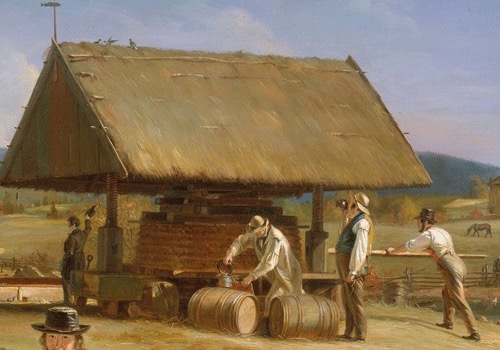
“Apple mills in Lancaster Dec 16, 1778
“In the greatest part of our march the inhabitants were making of cyder, for in almost every farm there is a press, though made in a different manner; some make use of a wheel made of thick oak plank, which turns upon a wooden axis, by means of a horse drawing it, and some have stone wheels, but they are mostly of the former.”
Anburey, Thomas. Travel through the interior parts of America.v2. London: 1789″
We then walked in downtown Gettysburg. We had been to the battlefield but hadn’t been in the town.


We then went to Garryowen Irish Pub for lunch.

They had Scotch Eggs on the menu so I had to have one.

Meanwhile we were following the wildfires back home. The evacuation levels had increased for the Labor Mountain fire which was making me nervous.

Here are antique chamber pots in their bathroom.

In taking the backroads back to Lancaster we drove by this monument to General Custer. It states “Brigadier General George Armstrong Custer Wolverines Three-fourths of a mile south of this site on the Hunterstown Road, newly appointed Brigadier General George Armstrong Custer led the Michigan Cavalry Brigade (1st, 5th, 6th, and 7th Regiments) in his first charge against superior forces of Confederate cavalry under General Wade Hampton and Cobb’s Legion on July 2, 1863. During the attack, Custer’s horse was shot from under him. Without a horse but uninjured, he found himself prone to the mercy of Confederate blades that bore down on him. This decisive first encounter nearly proved fatal if not for the bravery and quick thinking of Norvell Francis Churchill, Company “L” 1st Michigan Cavalry, who deflected a saber blow and pulled the “boy general” to the back of his steed, extracting him from harms way.”

Also on the way back we drove over the Columbia – Wrightsville Bridge over the Susquehanna River. My photo does not do it justice.

Back at our hotel, it really started raining. This was our hotel room window. There was quite a bit of thunder and lightening too.
Since we didn’t want to walk or drive anywhere for dinner, we decided to just go to the hotel bar for dinner. We did split a nice roast chicken dinner while watching the storm.
The next morning I had an appointment for the Research Center at the LancasterHistory Museum. I was able to take photos of the contents of the Reigart family file there. I haven’t had a chance to review them yet but thought I would post them here so family members can look as well.
In the hallway outside of the research center was a desk/bookcase that the Jenkins family had at the Windsor Forge mansion.


We saw a lot of Halloween decorations all over Pennsylvania despite the fact it was September. This was one of the more impressive ones.

We also saw a lot of things in the area named Oregon. I was curious, which came first, the state or this area of Pennsylvania. But it turns out the state came first.


We had checked out of our nice hotel in Lancaster and were heading to Philadelphia taking backroads looking for more cemeteries. The horse and buggies were a bit of a challenge.

There were slo a lot of barns with drying tobacco leaves.

We went to the Showalter Cemetery now known as Bethany Evangelical Congregational Cemetery. We found the grave of Jacob Showalter. He is the great, great, great, great grandfather of my stepfather Al Showalter. It was a pretty cemetery.

His gravestone is on the far left of this photo with his wife Barbara next to him. His military service: Private in Capt William Crawford’s Company of Militia, Lancaster County, Pa. He had immigrated from Germany. Their children Lydia and Samuel are next to them.

This is Jacob’s brother John. I did put some flowers on their graves. These ones were from the Lancaster Central Market.


One thing that struck me is that the ancestors of Al and of my mother lived relatively nearby each other in the same time frame. I think that is interesting.
We ended up back at the Historic Poole Forge to have a picnic lunch. We spotted some items we missed the first time.


Then we happened to drive by Caernarvon Historical Society and Museum and noticed it was open. They were planning a talk about the local forges the following weekend which I could go to. But they had a lot of information laid out getting ready for this event. So there was a lot of information about the Jenkins family, the forge and Blanche Nevin. I haven’t had a chance to look at it all yet but have it posted here for family to view.
Here is a painting of Catharine Carmichael Jenkins.

And this is a map of Penn Land Warrants, Surveys and Patents. There are quite a few belonging to the Jenkins family (John, David and William), the earliest dating back to 1733.


Then we went to Forks of the Brandywine Evangelical Presbyterian Church to find the graves of Rev. John and Catharine Mustard Carmichael.


Here are their graves. There were the parents of Catharine Carmichael Jenkins. John had immigrated from Scotland in 1737 with his parents. Catharine died 15 days after giving birth to her daughter. He was the pastor of this church in 1761. Per the History of Chester County, Pennsylvania: With Genealogical and Biographical; By John Smith Futhey, Gilbert Cope 1881 “He was an earnest, uncompromising friend of American liberty. Some time before the Revolution he devoted his pen, in a series of articles published in the papers, calling upon the people, while they should maintain fidelity to their king, to stoutly resist oppression by the English government. In 1775, one year before the Declaration of Independence by Congress, at the request of the militia of the town of Lancaster (Capt. Ross’ company), he preached a sermon to them against the tyranny and usurpation of the crown of Great Britain. He succeeded in instilling the principles of patriotism into the minds of the people to whom he ministered to such an extent that when they were called upon to serve their country not a man of them hesitated or faltered. When Congress convened in Philadelphia he visited the members personally, urging them to action. As the war went on his activity in the cause was incessant. He and Rev. Robert Smith, of Pequea, were with the army at the battle of Brooklyn; and when it lay at Valley Forge he literally stripped his house in supplying its needs. On one such visit, learning from Gen. Washington that they were greatly in need of linen with which to dress the wounds of the soldiers, he returned home and stated the fact to the people of his charge, observing to the women, “Now, each of you can spare so much linen,” measuring off on his arm. In a day or so a large number of small packages of linen were brought to his house, with which he filled to bags, and mounting his horse, conveyed them to the camp. The timely supply was followed by a letter of grateful thanks from the commander-in-chief. At length the British set a price on his head, and when their army occupied Philadelphia many attempts were made to take him, which failed, his faithful people keeping scouts out all the time to warn him of danger.”


I did put flowers on their graves as well.

We then made it to Philadelphia and checked into Penn’s View Hotel. We decided to walk around and see the sights. This is Independence Hall.

Unfortunately it started raining and hard. So we made it back to our hotel and took a seat at the bar as we were too wet for the nice dining tables in my opinion. They have the Panorama wine bar which has the Guinness world record for largest wine keeper. There were an impressive assortment of wines there.

I got the red wine Italian Classics flight while Tom got a glass of Nebbiolo “Tumlin Estate~Roero” Povero 2020 on the recommendation of the bartender to pair with his dinner. This was on my flight list and was my favorite of the group.

We got the Bruschetta as an appetizer, Tom got Pork Tenderloin for dinner and I got Rigatoni. It was all amazing.

They even had a Philadelphia Eagles wine.

The following morning I was receiving notifications of activity in our driveway. This started at around 6 AM and continue until 8 AM. This was while I was getting ready and driving to a medical conference I was attending.
I texted Tom to get ahold of our neighbor whose cows I thought they were. I was worrying about them in the dark with cars driving by. It was about 5 AM pacific time when he got ahold of him, but he took care of it. I am still not sure how they got out. Tom got to sightsee while I was at the conference. This is Betsy Ross’ house.


When I got out of my conference I had wanted to see the Italian Market. Unfortunately it was mostly packed up by the time we got there.

We did go to Philly Cheesesteak corner and got cheesesteaks from Geno’s. I know this is controversial, but it was on the advice of friends and family that have lived in Philly.

The next morning I was back at the conference. Tom say this motorcycle in the window of a barbershop. He decided to get his hair cut there.

There was a protest going on nearby with some police presence too. No violence occurred that he could see.

He had breakfast at this restaurant by our hotel. He said it was excellent. Unfortunately I was never able to try it.

After my conference we headed to the site of the City Tavern. One of my bigger regrets is not be able to eat here while it was open. I am a huge fan of Chef Staib. But I got to see the building where it happened.


We then headed to the Museum of the American Revolution. Here are the photos I took.
I hadn’t realized that women had the right to vote in New Jersey until 1807. The photos of the Revolutionary War participants were fascinating to me. I hadn’t realized that there were photographs of them.
Then we headed to Independence Hall. Unfortunately I had not realized that you needed to preorder tickets to see a tour of the inside. So that was a huge disappointment. But we got to see the outside.


Then we headed to the attached museum at the Philosophical Hall. Its current exhibit is Philadelphia, the Revolutionary City. Here are photos from this museum.


Then we went across the street to see the Liberty Bell.


We then walked to Christ Church Burial Ground. On the way I saw the US Mint.

We wanted to visit Benjamin Franklin’s grave. Here it is.

My brother had warned me about the pennies but thought it was opposite of his advice that a penny saved is a penny earned. Anyway, I got 4 pressed copper coins from the Museum of the American Revolution gift shop and one of them was left on his grave. One we are keeping and the other two went to the grandkids.

This is what the graveyard looks like.

And here is Benjamin Rush’s grave. He is a relative of sorts. His great grandfather William Rush born 1652 is a direct ancestor of ours. I do admire him though.


Then we walked the streets of Philadelphia where we saw things I wish we hadn’t to go to McGillin’s Olde Ale House, oldest bar in Philly. It was pretty raucous. It was Friday evening but early.


Then we went to Moriarty’s Restaurant for dinner. It had amazing glass light fixtures. The food and cider were good. It wasn’t raucous.

This was the Custom House on our walk back.

The next morning I went to my conference, and Tom enjoyed a mocha and pastry.

He then visited the Rittenhouse Farmers’ Market. After my conference I parked nearby and walked to meet him. Here is the College of Physicians of Philadelphia.

We meet at Dolce Carini Pizzeria so I could finally have a tomato pie. I am guessing this is not the most authentic one in Philly (the people in the restaurant were all speaking Spanish) but it was tasty. I am glad I got to have some.

Then I headed to the Mütter Museum. Tom was not interested so headed back to the farmers market. It was fascinating for me. I could see diseases that I have never seen before in three dimension form like tertiary syphilis and advanced tuberculosis. As of August they no longer allow personal photographs of the contents of the museum which I understand completely. But I would have wanted to take photos of some of the disease depictions in the museum. Outside the museum there is the Benjamin Rush Medicinal Plant Garden.

There was a variety of medicinal plants. I have visited several medicinal plant gardens in the past which have impressed me. This one is small but pretty.

On the way back to the parked car, I saw this Armory.

We then drove around. I had wanted to see the Rocky statue at the Philadelphia Museum of Art. Traffic and parking were crazy so I settled for driving by it.

We drove to the Laurel Hill East Cemetery. This was to see the grave of my great great grandfather John Stone. He is my great, great, great, great grandfather who immigrated from Liverpool.


This is his daughter Helen Stone.

These are his sisters Hannah and Esther Stone.

And the flowers which came from the farmers market.


This cemetery was amazing. There were some young adults filming what appears to be a horror movie there.


We then headed north to the Young American Hard Cider & Tasting Room. I had a Cider Penicillin which was quite gingery, and Tom had the traditional cider.

We then drove through North Philadelphia which was a little sad and went to Commonwealth Ciders at the Philadelphia Brewing Co. We had the traditional dry cider and watched some football.

We then drove a little ways away and went to the Meetinghouse. It was quite crowded and we were able to watch a little Phillies baseball and drank a quick cider.

We made it back to our hotel room and were able to watch the Oregon Penn State football game, and the Ducks won!

I became curious about what Nittany is. So I googled it, and it is a mountain north of Gettysburg. So now I know.

We checked out of our hotel. I had wanted to go to the Eggcellent Cafe, but it was too busy on a Sunday morning. But I did see this sign describing the London Cafe across from our hotel which was an inspection and auction site for newly arrived African slaves.

As we were going to the airport we were able to drive by Lincoln Financial Field where the Eagles play and Citizens Bank Park where the Phillies play.


We flew home via Dallas. It was nice to see our beautiful Seattle again. Traveling does make you appreciate home more.


You do such an amazing job of researching our family histories. Very enjoyable to read as Amy and I sit here on a hillside looking out over the Lancaster County farmlands from our RV campground only 6 miles from Churchtown.
Thank you. It was a rush job getting this post done by the end of the weekend. I am sure there are typos and grammatical errors. I am glad that you both enjoyed it. I hope your trip to Lancaster is amazing. Ours was. I need to do a lot more research now though. There is a lot of information from the Lancaster and Caernarvon museums that I need to look at.