Oskar Johansson’s home site sign translation

Below is the google translation of the sign at the site of his homes.

Bjennsjön nt! The last settler was Oskar Johansson born in 1886 in Yttersniark, raised on Bynäset, Botsmark. Married to Elsa Lundström born 1892 in Bratfors Savar. They moved here from Kvarnbackeni Botsmark in 1913 with their daughter Magnhiid born in 1912. Oskar worked as a forest manager at a forest company In Bjennsjön was born Elfrid in 1914, Margit 1917, Maria 1920 and Edmnd in 1923. a home in Häggnäs for new cultivation On 11 Aug. In 1926, the dwelling house burned down, probably after the soot fire that had previously been on the morrow. At home was Magnhild with her little siblings Maria and Edmund, they had gone to the forest to pick some blueberries and on the way home saw that it was smoking from the roof. Magnhild ran home and tried to extinguish the fire in the wind with the help of a fire extinguisher and almost succeeded but saw that help was needed here and ran to Kettbergheden. She soon met Albert Larsson and another man who came to cut, but the fire had taken hold in the sawdust. The wind blew against the baker’s cabin echiven it and the log cabin, recently filled with firewood for the year, burned down. Everything of value brano inside. The other family was in Häggnäs for mowing. The family lived in a bakery cottage Häggnäs for a start. The lodge in Bjennsjön was demolished and sawed to boards for a new dwelling house in Haggnas and a larger barn where the barn was furnished for the first winter. Haggnäs extended the family with Maida in 1927, Majvor in 1931 and Karl-Olov in 1933. Sa bley Bjennsjön a “replacement” and in mowing the family moved here with cows and lived in a stall that stood on the plot and brought along the kitchen equipment needed. A small stove was placed outside the booth to be used for cooking. On the 4th of August In 1931 the mower Bjennsjön was finished and the hay loaded. Mother Elsa had cooked porridge and went to those who loaded the last cage, which would be taken home, so that everyone would have eaten before they started walking towards Häggnäs. On the way back, she sees how the living room is burning with all the kitchen and bedding that is used. The wind blows towards the barn so it also ignites and all loaded hay burns up, even 2 bikes and div. horse-drawn vehicles. It has been speculated on the cause, if it had dropped glow from the stove on the ground or if any of the calves had pushed it. Bjennsjön was not a successful venture for the young family. * 2004 GJ

Posted in Trips | Leave a comment

Sweden Trip Day 9, Johansson Tour

It is sadly the last day of the reunion. We started, of course, with a Swedish breakfast. Then there was the closing ceremonies, and the reunion banner was passed off to the new planning committee. In three years the reunion will be in Saskatchewan.

After there is Dan who lives near Seattle visiting with his sister and cousins who live in Sweden.

This is a whiteboard that the children drew on during the reunion.

Then we started the tour of Johansson sites. The first that we drove by though is listed as a home of Carl Zingmark. He was my GGGG grandfather. I am not sure if this building was his or not though.

This is the barn that is in front of the property that Jakob Johansson and his wife Ester Amalia Zingmark has a farm. It may be that some of these timbers were from their buildings. But I love the design of the barn’s ramp. I think we need one of these for our barn.

Then we walked a ways back. This is what I called the brain trust leading us. They keep the family information. It is Ann-Brith, Cecilia and Gull-Britt.

The view of the lake is gorgeous. Manghild was one of the early grandchildren of Johan and Ester and had a cabin on the opposite side of the lake that could be reach by row boat.

This is the mixture of trees on the property. Birth is prominent.

This is the site of the house.

And this is the site of the barn. In our family this barn is ominous because Ester and her son Knut died of the Spanish flu in January 1919. The ground was too frozen for a burial so their bodies stayed in the barn until the spring. In the meantime the surviving and remaining children had to keep the vermin away ( Axel had already died of the flu in September).

There was some equipment and the barns ramps still evident (with Cennert demonstrating).

This is Sanna in the woods. She was one of us who were up until 3:30 am.

Here is my more immediate family minus my mother. It is Christina, Keith, Amy and Craig. And it is the latter two’s 40th wedding anniversary today.

This is the home back at the road. Apparently the timbers from Johan’s house were used to build this home.

Then we went to Gunnel and Allan’s home which is where Johan’s father Jakob Jakobsson (Little Jakob) lived. But first we had to see the largest birch horn in the world built by their ancestors. It is quite the horn. It was played by Dan and Allan.

Here is the site of Jakob’s home and a remaining lamp and old apple tree.

We then continued our Swedish caravan to the Botsmark Bygdegård for a lovely lunch.

There were maps of how Botsmark has changed. Johan’s farm was on the peninsula on the far right.

There was also information about a famous annual local cross country skiing race here. Dan used to participate in the 1970’s before he immigrated.

We then went to the site where Johan’s first son Oskar built two houses that both burned down. The second fire also took out the barn that they had just filled with hay for the winter. There is a sign describing the events that I need to translate as well as a small foundation, probably of an out building and a rusty basin. There are huge mushrooms too.

The Swedish caravan started breaking up. I went with some relatives to the Sävar church. Here I found a Zingmark grave for another descendant of Carl Zingmark. Per https://www.svenskagravar.se/ there are other Zingmark buried in this cemetery as well.

Then we came to this gravestone. Oskar’s son Edmund and his wife Birgit Johansson are buried here. But also Johan, his wife Ester, his second wife Hilda, as well as three of Johan’s children Axel, Knut and Erik. They do not have gravestones.

This is Sävar’s church. Apparently the Zingmarks built s replica of this church in Salem, South Dakota.

I met up with my family in Umeå and we went to the Böten restaurant which is actually a boat. The views and food were amazing.

That is it for today. Tomorrow Amy, Mom and I plan to explore Umeå. Craig is going to rest and recuperate. Keith, Kyle and Christina are off to Rome.

Posted in Trips | 1 Comment

Sweden Trip Day 8, Reunion

This is the big reunion day. Warning: there are lots of photos. The day started off with going to the local open air museum. I was fascinated by all the antique fiber equipment, farming strategies and veterinary devices. Our hosts were well informed as well.

This spinning wheel looks a lot like the one I had inherited from Sweden from my great great grandmother.

These are naturally dyed mini skeins with tags in Swedish as to what was used. I can tell indigo was used for blue and onion for yellow but not sure yet what made the red shades.

You can appreciate how well worn this loom was.

Baby equipment including Sami/Lapp.

handmade furniture

Our guide did describe how hard times could be in these northern Swedish farms. In years of famine, the lakes could remain frozen through the summer and many people would starve to death.

More fiber equipment

Below is the home where my great great great grandfather Jakob Jakobson was born. His father also grew up there, and his grandfather built it. It was moved to the museum from Kamsjön.

The left side of this building was used just a few times per year for baking flat bread.

This is a flax break.

This was an inventive cattle watering system.

This is veterinary equipment.

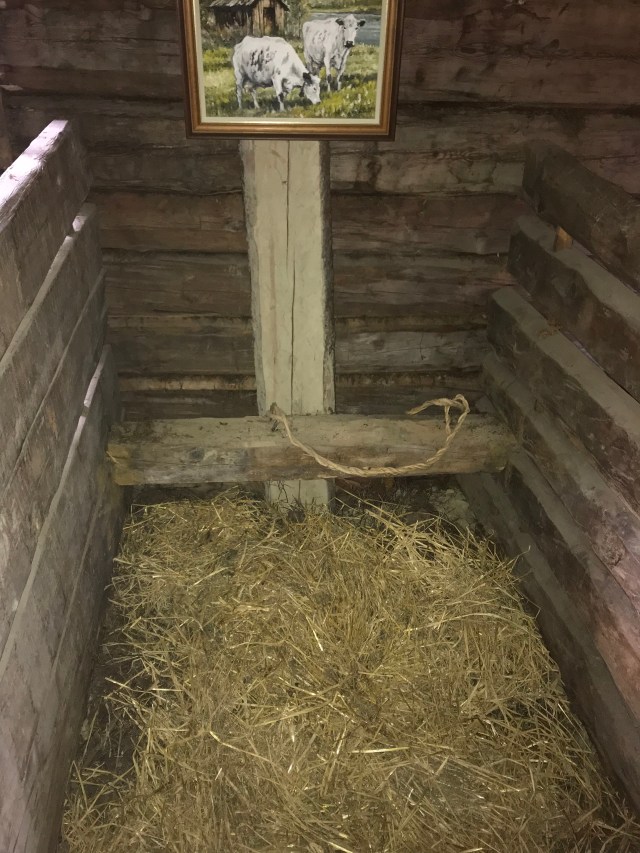
This is where the cattle spent their entire winters.

This is the trap door behind the stalls where the manure was deposited. In the spring it was manually spread on the fields.

More veterinary equipment.

This is where the water came into the barn. I suspect the fireplace was just to keep the water for freezing.

A variety of wagons and a hay mower. The second one was for moving hay.

This building houses a horse drawn barley grinder.

This was another smaller animal barn where their small cows would spend the winters. You can see where they chewed on the wood of their hay feeder.

Below is the hurdle that was used to dry barley.

A small cabin with a wooden chimney.

A food storage building.

We returned to our hotel. I find the cars’ hitches here interesting.

We had a nice lunch.

Then it was time for photographs. There were 13 siblings born near here in Northern Sweden that we all descended from. These are the descendants of Johan Oscar.

The descendants of Anders Alexius (Andrew).

these are the descendants of Petrus Nicolaus.

These are the descendants of Karl Ragnar.

These are the descendants of Jacob Halvar.

I did not get a photo of our group, the descendants of Emil Gottfrid.

The remaining siblings either died before reproduction or did not have attendees here.

These are the remaining members of the children of these 13 siblings that were able to attend.

We then had a demonstration of ancient Swedish basket weaving using only birch root, a knife and a bone.

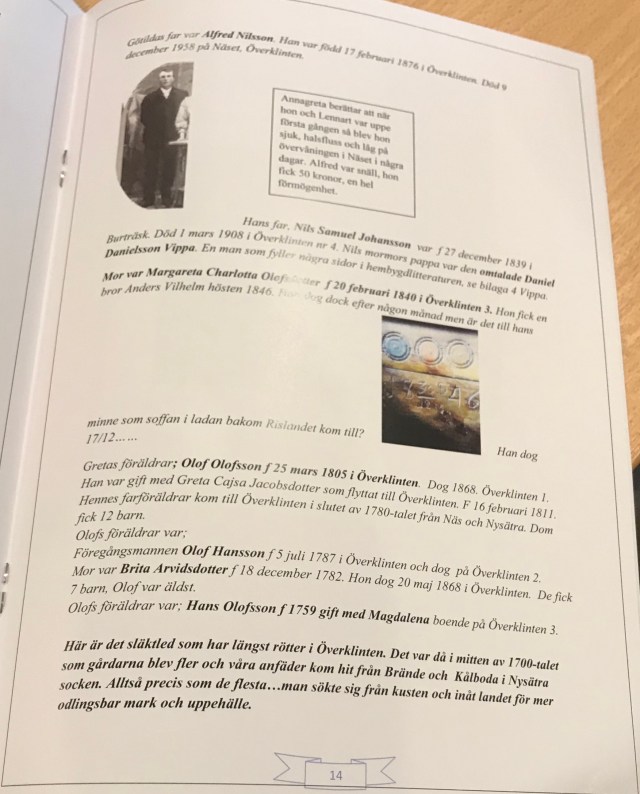
Then we had a discussion of our previous ancestors and their locations. Below are photos from some of Cecilia’s research that I need to review.

There were also letters between the siblings in Sweden and in North America that had been translated by another family member that I need to read more carefully.

There were quite a few young children at this reunion. This is a rare quiet moment for some of them.

Here is a photo of Daniel, one of the main reunion organisers, and Gunnel, the basket weaver.

We had a nice dinner,

Completed an auction supporting the reunion ( this is Rob who won a clock that the oldest sibling Oscar had owned),

And the listened to Swedish folk music.

For the remainder of the night some of us went to the second floor lounge, drank and talked until the wee hours of the morning.

This was a truly memorable day that I will never forget.

Posted in Trips | 4 Comments